Why a Country Can Run Out of Dollars Without Running Out of Money
A central bank can create more of its own currency. It cannot create the dollars, euros or other foreign currencies needed to import fuel, repay an external bond or settle a cross-border invoice. That second constraint can turn an ordinary slowdown into a national crisis.
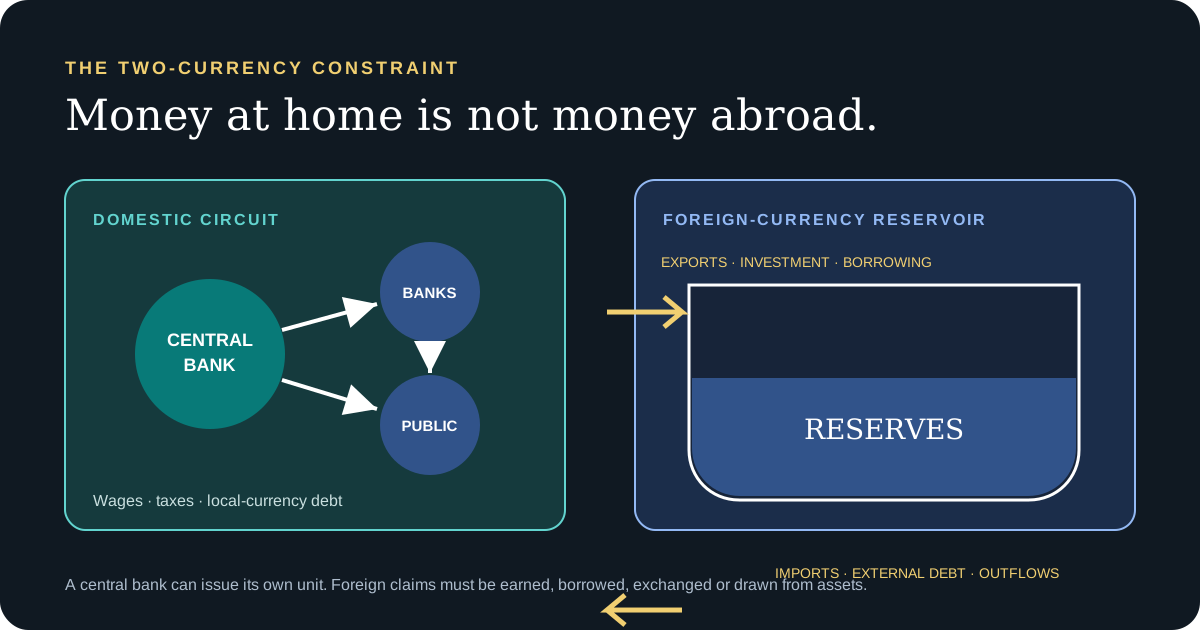
Domestic money circulates inside the economy. Foreign currency must enter through trade, investment, borrowing, transfers or reserve exchanges.
A government pays teachers in its own currency. A local shop accepts that currency for groceries. Taxes are assessed in it. The central bank can create more balances in the domestic banking system if its legal framework permits.
Now consider an importer buying medicine priced in dollars, an airline paying for fuel abroad or a government servicing a dollar bond. The seller wants a foreign-currency claim. Printing more domestic notes does not manufacture that claim. Someone must be willing to exchange dollars for the local currency—or the country must use foreign assets it already owns.
The IMF defines a balance-of-payments problem as a situation in which a country cannot pay for essential imports or service external debt.1 The country may still have banks, tax revenue and abundant domestic money. What it lacks is usable external purchasing power.
Domestic money and foreign money solve different payments
A sovereign currency issuer has substantial capacity inside its own monetary system. It can settle domestic-currency obligations through accounts ultimately anchored at the central bank. That does not guarantee stable prices, political consent or productive resources, but the payment mechanics are under domestic control.
Foreign currency sits on somebody else’s balance sheet. It may be earned by exporters, received as remittances, invested by foreign companies, borrowed from lenders or held as official reserves. Each route has conditions. Export earnings depend on demand and prices. Investment can reverse. Borrowing creates future payments.
Choose the bill and see who can settle it
The state must still mobilise real goods, labour and political support, but it does not first need to obtain dollars to credit local accounts.
This is the first distinction: currency denomination matters as much as the size of a liability. A government may owe a large amount in its own currency and a smaller amount in foreign currency, yet the second bill can be harder to settle during stress.
Foreign currency enters and leaves through a national ledger
The balance of payments records transactions between residents and non-residents. The IMF’s seventh-edition framework, released in 2025, integrates transactions with the stocks of external assets and liabilities and gives more attention to currency composition and external sustainability.2
Exports, tourism receipts, remittances and income from foreign assets can bring foreign currency toward residents. Imports, travel abroad, profit remittances and interest payments create demand in the other direction. Financial flows—investment, loans and securities—can finance a gap or suddenly reverse it.
Change one flow and follow the pressure
The exchange-rate effect still depends on import demand, saving decisions, hedging and whether exporters convert or retain their earnings.
The accounts always balance after prices, financing and reserve changes are recorded. A “balance-of-payments deficit” in ordinary speech means pressure somewhere inside that accounting identity—not that accountants have lost a line. The exchange rate can move, reserves can fall, new debt can arrive or payments can go into arrears.
A trade deficit is not automatically a crisis
A country can import more goods and services than it exports while attracting durable investment or borrowing for productive assets. Another can post a trade surplus yet face a rush to move private wealth abroad. The current account and financial account must be read together.
What matters is the reliability, currency and maturity of financing. A factory financed by long-term equity behaves differently from short-term foreign-currency debt that must be rolled over every few months. The IMF’s research finds that the size and composition of external liabilities matter: foreign-currency external debt raises vulnerability to sudden stops, while reserve assets can mitigate risk, with diminishing returns.3
Same gap, different vulnerability
The investor owns a claim on future profits rather than a fixed foreign-currency repayment date. It can still leave through a sale, but not like a maturing loan.
Reserves buy time, not immunity
Official reserves are external assets controlled by monetary authorities and readily available for external payments, exchange-market intervention and other purposes. They may include foreign-currency securities and deposits, monetary gold, IMF reserve positions and SDR holdings under the applicable statistical definitions.4
A central bank can sell foreign currency to meet urgent demand or slow a disorderly depreciation. The BIS notes that reserves can act as a buffer against capital-flow pressure.5 But every sale reduces the stock available for the next payment. Defending an exchange rate that markets regard as unsustainable can turn a gradual adjustment into a countdown.
Change the shock and watch the buffer shrink
The fictional reserve stock rises. Real adequacy depends on imports, short-term debt, contingent liabilities, exchange-rate regime and access to finance.
Illustrative units only—not a forecast or an adequacy assessment for any country.
Reserve adequacy is therefore multidimensional. Months of imports matter for trade disruption; short-term external debt matters for rollover risk; broad money can matter when residents can convert deposits; derivatives and commitments can create demands not obvious from headline reserves.
The exchange rate is a price—and sometimes a shock absorber
When demand for foreign currency rises, a flexible exchange rate can depreciate. Imports become more expensive in domestic currency, exports may become more competitive and demand begins to adjust. The movement can be painful, especially where food, energy and medicine are imported.
A fixed or tightly managed rate suppresses some immediate movement, but the central bank must supply foreign currency at the chosen price. Interest-rate increases, intervention, fiscal adjustment, macroprudential measures and capital-flow management can each affect the pressure through different channels.
Choose the first response to external pressure
They supply foreign currency now but cannot permanently replace an underlying shortage. Sterilisation and balance-sheet effects also matter.
BIS research published in 2026 describes FX intervention as an additional tool alongside interest-rate changes: selling reserves can lean against excessive depreciation and improve liquidity, though usefulness and effectiveness vary with market structure and circumstances.6
Foreign-currency debt turns depreciation into a larger bill
Suppose a company earns domestic currency but owes $100 million. If the local currency loses 20 per cent of its dollar value, the debt has not changed in dollars. Measured in local currency, however, it becomes 25 per cent larger: what once cost 100 local units now costs 125.
This currency mismatch can weaken firms, banks and governments simultaneously. Import costs rise, borrowers need more local revenue to buy each dollar, collateral values change and lenders become reluctant to renew credit. A floating exchange rate still clears the market—but at a price that can damage balance sheets.
Depreciate the local currency
The borrower still needs dollar income or access to the FX market when payment falls due.
Arithmetic illustration only. It excludes interest, hedges, asset values, taxes and accounting rules.
A sudden stop can become a self-reinforcing loop
Foreign lenders may stop rolling over loans because they fear depreciation or default. Residents may also seek foreign assets. The currency weakens, foreign-currency debts become harder to service and banks appear riskier. That validates some of the original fear and encourages more outflow.
The spiral is not purely psychological. Maturity dates are real. Importers need working capital. Banks must settle cross-border positions. But expectations determine how many actors demand foreign currency at once—and how quickly a liquidity problem becomes a solvency problem.
Advance through the feedback cycle
If many borrowers and investors seek foreign currency together, a market that looked deep in normal times can become one-sided.
The global FX market is enormous, but access is uneven. The BIS’s 2025 Triennial Survey—final results released in June 2026—maps turnover and settlement across currencies, instruments and financial centres.7 A national shortage is not proof that dollars have vanished globally; it means the country cannot obtain enough at the price and terms it was relying on.
Why creating domestic money does not close the foreign gap
A central bank can create local currency and offer it for dollars. If confidence and demand are unchanged, more local currency chasing scarce foreign currency tends to push the exchange rate down. The country obtains dollars only because somebody accepts the other side of the trade.
Money creation may help domestic banks meet local-currency obligations, but it can intensify inflation, depreciation or capital flight. The constraint is ultimately real and external: export capacity, investor willingness, contractual currency, available reserves and the time before payments fall due.
External debt service can become especially binding when financing costs rise. The World Bank’s International Debt Report 2025 tracks external debt stocks and flows for reporting low- and middle-income countries and stresses the importance of transparent debt data and repayment burdens.8
Adjustment, financing and restructuring solve different pieces
A country facing external pressure can reduce imports, increase exports, allow relative prices to change, attract financing, use reserves, negotiate official support or restructure debts. Each option allocates losses differently and operates on a different timetable.
IMF lending is designed to provide breathing room while adjustment policies address balance-of-payments problems.9 It does not make the constraint disappear. It changes the timing and financing available while the country tries to restore a sustainable relationship between external income, obligations and confidence.
Match the remedy to the problem
This works only if future inflows are likely to cover the obligation. Borrowing cannot permanently solve an underlying solvency gap.
SDRs can supplement official reserves and be exchanged for freely usable currencies, but the IMF is explicit that an SDR is not itself a currency.10 Like a credit line or swap arrangement, it can strengthen liquidity without creating domestic productive capacity.
The 2026 IMF External Sector Report emphasises that current-account positions must be judged multilaterally and in light of domestic policies rather than by treating every surplus as virtuous or every deficit as a failure.11 One country’s balance is linked to another’s, and abrupt adjustment can transmit stress across borders.
A country “runs out of dollars” when its immediate foreign-currency claims exceed what it can earn, borrow, exchange or credibly mobilise at acceptable terms. The visible symptom may be a falling currency, import queues, controls, reserve loss or missed payments. Beneath each is the same mismatch between two monetary circuits.
A country can print the unit in which it taxes. It cannot print the unit in which the rest of the world insists on being paid.
Sources & further reading
Research checked September 12, 2026. Interactive quantities are fictional unless a source and measurement basis are stated; this article is an explainer, not an assessment of any country or investment advice.